A scientific seminar on "Water-based two-phase systems and their application prospects" was held at the Institute of Biophysics
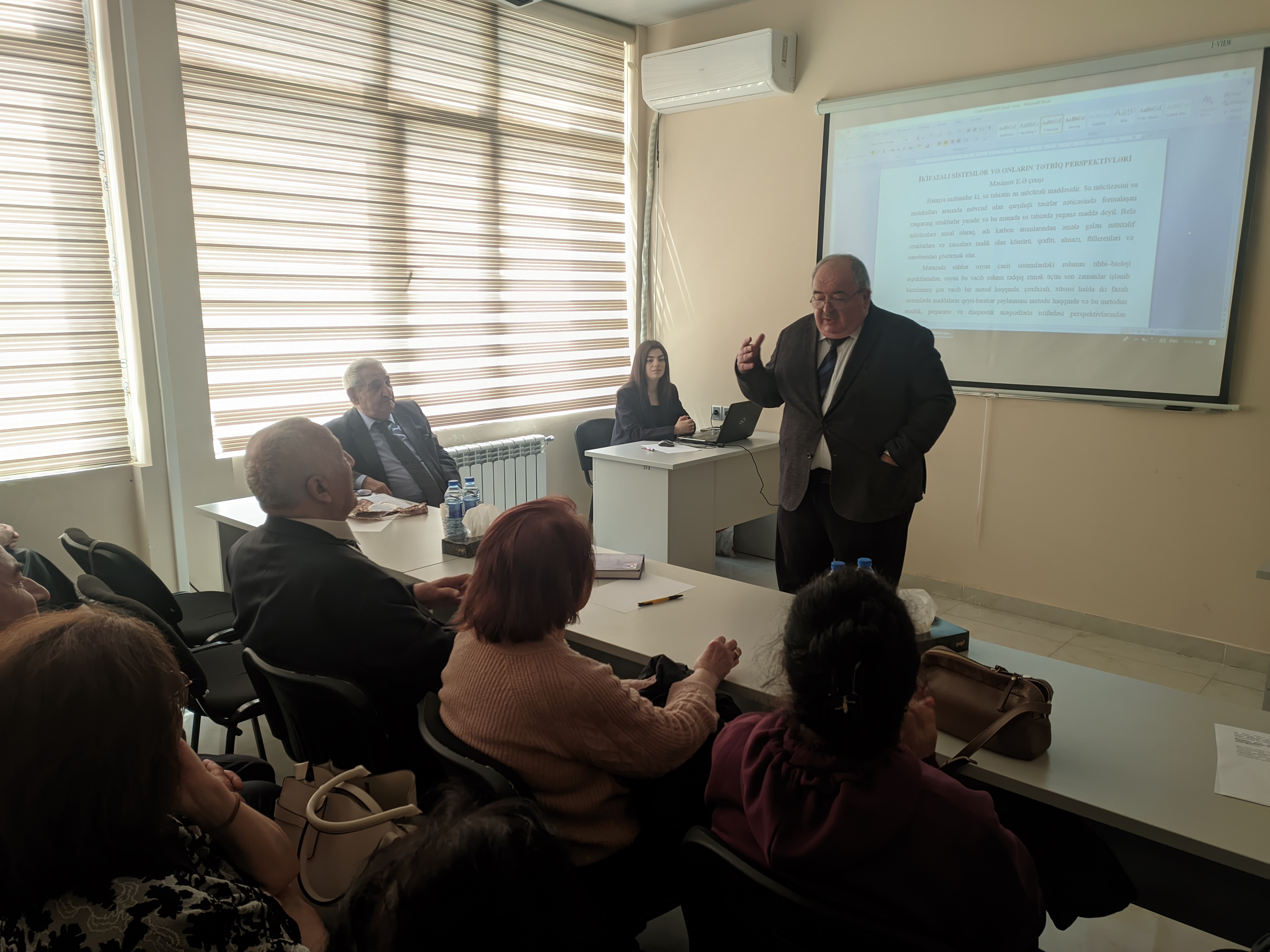


On April 24, 2025, the Institute of Biophysics of the Ministry of Science and Education of the Republic of Azerbaijan hosted a scientific seminar on the topic "Aqueous Two-Phase Systems and Their Application Perspectives." The keynote speaker at the seminar was Professor Eldar Məsimov, Doctor of Physical and Mathematical Sciences, from the Department of Structure of Matter at Baku State University.
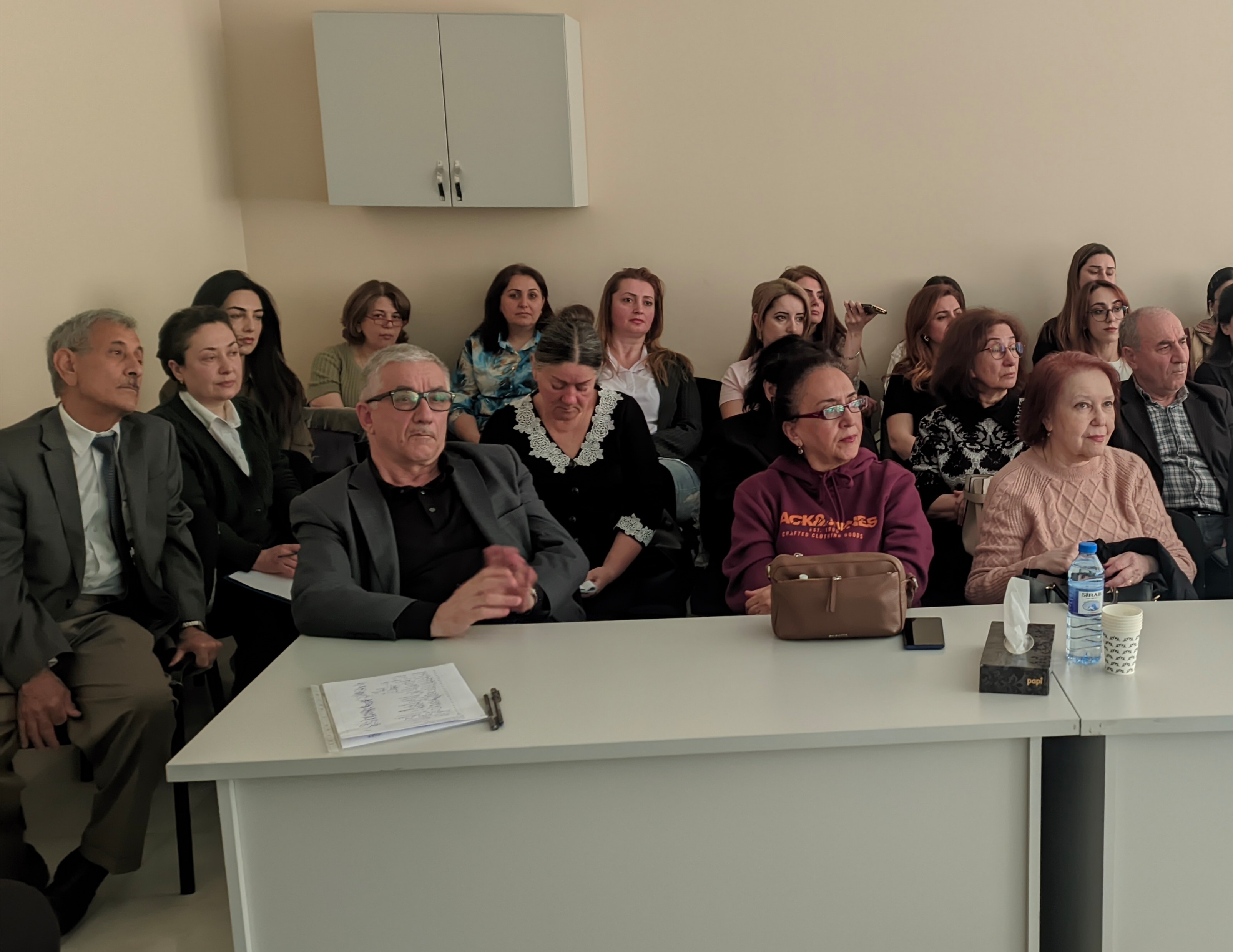
The event was attended by Professor Niftalı Qocayev from the Department of Optics and Molecular Physics of the Faculty of Physics at Baku State University, staff members of the Biophysics Department of the Research Institute of Physics Problems at Baku State University, and graduate students from the same university.
The seminar was opened with a welcoming speech by the Director General of the Institute of Biophysics, Corresponding Member of the Azerbaijan National Academy of Sciences (ANAS), Oktay Qasımov. He warmly greeted the participants and emphasized the significance of the seminar topic in the fields of science and education. He stressed the importance of a thorough exploration of both theoretical and practical aspects of the topic and requested Professor Eldar Məsimov to provide an in-depth explanation of the theoretical foundations and functional aspects of the subject. Oktay Qasımov also expressed hope that the seminar would give rise to interesting and useful ideas regarding scientific and technological applications in the future. In his address, he also highlighted Professor Məsimov’s extensive experience and expressed deep respect for his scientific work.
During his presentation at the scientific event of the Institute of Biophysics, Professor Eldar Məsimov emphasized the critical role of water in living organisms and the importance of two-phase systems in this context. He pointed out that water not only functions as a solvent but also directly influences biological and biochemical processes. He explained that hydrogen bonds formed between water molecules and the resulting dynamic structures are responsible for these effects.
Məsimov highlighted the unique properties of water and noted that these are explained by its physical and physico-chemical anomalies. He emphasized that extremums in indicators such as density, surface tension, and dielectric constant distinguish water from other liquids. The two-structure liquid model, proposed by Bernal and Fowler and further developed by many scientists, is based on these properties.
The speaker explained that two-phase systems are based on the principle of unequal distribution of substances, and this approach opens new opportunities for effective separation and analysis of components in biological environments. He emphasized that the analytical, preparative, and diagnostic use of two-phase systems paves the way for innovative applications in medical and biotechnological fields. One of the main advantages of this method is its ability to study living systems using models that closely resemble natural conditions.
Professor Məsimov also gave special attention to the concept of the “hydrophobic effect.” He explained that this effect, observed during interactions between non-polar substances or those containing such groups with water, can be described in terms of Gibbs free energy. At the molecular level, the ratio of hydrophilic to hydrophobic groups determines the solubility and functional characteristics of biological molecules in water.
The scientist also discussed the characteristics of polymer and electrolyte-based two-phase systems. In such systems, the aqueous phase is hydrophilic while the non-polar phase is hydrophobic. The distribution of substances depends on the difference in hydrophobicity between the phases. He noted that these systems are important for evaluating hydrophobicity in biological and pharmacological contexts and for measuring the impact of substances that alter their structure in aqueous environments.
Məsimov also underlined the significance of two-phase systems in the separation of biological particles. He noted that these systems operate in a very "gentle" and contactless manner. Furthermore, he pointed out that such methods could potentially be used as indicators of pathological changes.
Following the lecture, the Director General of the Institute of Biophysics, Corresponding Member of ANAS Oktay Qasımov; Professor Niftalı Qocayev; Executive Director of the Institute of Biophysics Dr. Karim Qasımov; Associate Professor, PhD in Biology Taleh Yusifov; Doctor of Physical Sciences Gülnarə Haqverdiyeva; and PhD in Physical Sciences Xavər Həsənova shared their questions and thoughts regarding the seminar topic.